As the Japanese had no formal writing system of their own, they used the Chinese characters which is now modern day Kanji. There exists some 40,000-50,000 Kanji, although only a small fraction of those, about 2000, are actually used in day to day writing. In any one sentence there can be glyphs of all three writing systems.
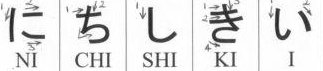
Hiragana mostly used for:
words with extremely difficult or rare Kanji,
colloquial expressions,
Japanese words which are not normally written with kanji, such as adverbs and some nouns,
adjectives, or for words whose kanji are obscure or obselete,
ending of verbs and adjectives,
postpositional particles, auxiliary verbs,
words without Kanji.
Hiragana may also be written alongside or on top of words; to help with the pronunication, grammar, and meaning.
When characters are added like this, they are known as furigana.
EXAMPLE TEXT
These lines of text show how kanji and hiragana are written.
The first line shows hiragana written with furigana,

and, this line written with kanji and hiragana;

While Katakana represents the same sounds as Hiragana, its' letters are different, and are used for newer words
imported from western countries.
Katakana mostly used for:
foreign words, borrowed words, Japanized English,
foreign names and place-names,
technical and scientific words,
names of animals, plants,
indication of the reading of kanji.
words for which there is no Kanji or hiragana,
You May Like:
Taste World Wines - Free Wine App
To practice how to write the letters : for hiragana; gohere for katakana gohere
To practice how to pronounce the vowels, together with consonant sounds: gohere -for hiragana chart, gohere - for katakana chart
FYI: if you click on W in the first row of the chart, it is in line with a, so the sound you pronounce is: wa.
You can listen to sound pronunciation for each character you click.
The vowels: a i u e o, are pronounced the same in Hiragana and katakana, however they are not written the same.
You can listen to pronunciations of Hiragana letters spoken by an English person; Go Here
Modern Day Japanese- What's Unique
Modern Japanese uses a writing format, called yokogaki (横書き?). This writing format is horizontal and
reads from left to right, as in English.
Japanese is typically written without spaces between words, and text is normally allowed to wrap from one line to the
next without regard for word boundaries.
The question mark (?) is not used in traditional or formal Japanese, but it may be used in informal writing.
Kanji, hiragana, and katakana are used for Japanese words and sentences, and any one sentence or writing
may have letters from all three alphabets; although Kanji and hiragana are used mostly.
Katakana is used for words that cannot be written in hiragana or kanji. As well, Katakana is used for 'Japanized English' words, making them look more like their original English
words.
Example words: cake - keeki, beef - biifu, enjoy - enjoi
In English, we say- 'I eat', and we write 'I eat', however, in Japanese, the speaking and writing
are different.
In Japanese, to say - I eat - 'watashi wa taberu', and writing, '私は食べる'.
Speaking Japanese - Intonation
Japanese language creates the challenge of learning proper intonation.
Intonation of high and low pitches, and for long/short vowels, is a crucial aspect of the Japanese spoken language, and the best way to get the proper
sense of Japanese sounds/pitches is by listening closely to audio pronunciations of the spoken words and sentences. Many online
language sites have free translation from English to Japanese, which is a good way to listen and practice your pronunciation of Japanese words.
Japanese Grammer Rules
For writing sentences in Japanese:
the verb generally comes at the end of the sentence,
the predicate is placed at the end of the sentence,
Japanese verbs can be formal or informal,
verbs only have a present tense and a past tense,and
Japanese present tense verbs(View all) commonly end with u - ru, mu, su, ku, iru, eru, tsu
verbs do not change because of subject (he/she/they/it/these/those/this),
nouns do not have a plural form or gender, and,
most nouns do not have a separate plural form,
particles(View all) follow the affected word - if subject or object,
Japanese particles are somewhat similar to English prepositions,
variation on the word sound can change its' meaning; thus intonation is important,
Japanese vowels can be long, short. Long vowel has a dash - placed on it to designate its' intonation.
Vowels can give words different meanings if they are short or long pronounced.
Basic Sentence Structure
In Japanese, a sentence has a SUBJECT, OBJECT, VERB
In Japanese writing, the verb is placed at the end of the sentence, unlike the English language, which is:
SUBJECT, VERB, OBJECT
As there is no spacing between words in Japanese writing; understanding a sentence can be a challenge, especially when first learning the language.
However, knowing the Japanese particles can help, as they are placed after nouns and pronouns and 'direct object' of verbs.
There are many particles, but the more common ones are quite easy to learn: wa, ga, wo(o), to, no, noni, mo, dake, nori.
In Japanese writing, verbs, nouns, and particles, are the most important aspect of a sentence.
Having a reference to Japanese verbs, and Japanese particles is necessary, as almost every Japanese sentence uses them.
Most sentences are written with hiragana and kanji in Japanese. Some use katakana, when there is no hiragana or kanji for a word. Complex sentences can have many nouns/pronouns and verbs/adverbs, adjectives, and one or more particles.
It will give you the letters for the sentence's noun, verb, pronoun, and particle(s) individually, so you can recognize each word in the sentence, and also you can see how verb, noun, particle are placed in the sentence. This is a very useful tool, especially when first learning to write Japanese.
When doing your word and sentence searches at this website, you will see ON (onyomi) and kun (kunyomi). These mean chinese(ON) and Japanese(KUN) letters. If Kanji is available use that first as your letters, and if not, then use one of the others - onyomi or kunyomi letters.
You can also paste a KANJI ideographic (character symbol) into the Kanji dictionary, and it will tell you the meaning of that particular kanji symbol, and also variations of it- including the written letters for the Kanji word.
English to Japanese For A Japanese Sentence
I eat chicken.
Firstly, we placed the English words 'I eat chicken' into the Bing, Japanese translator(free), and got the Japanese letters.
You can also listen to the 'audio pronunication of the sentence', just click the audio icon.
私は鶏を食べる
Next, we placed those Japanese letters into this Japanese sentence translator(free), and clicked Translate Now.
Now, we can see the Japanese sentence (and words) for our sentence (I eat chicken)
watashi wa niwatori o taberu
Then, we hovered our mouse over the sentence to see the Japanese sentence details.
Clicking on each word, shows additional info on it. See Example: for the word, 'chicken', its a noun, and spelled, 'niwatori'
view here
And,
鶏
if we click on
the 'Kanji details', we get more info on the Kanji for the word chicken: See Example:
Kanji details for word chicken
it shows the characters(aka ideographic) for Kanji for word chicken, also shows spelling, niwatori(KUN)Japanese.
Additionally, if you click on 'radical', you will see more Kanji characters, pertaining to word 'chicken'.
See Example here Kanji radical - word chicken
If you wanted to write the word chicken with Chinese letters, you
would use the letters next to ON(onyomi-Chinese) . However, for our sentence we are going to use the
Kanji Japanese characters 鶏 chicken
The translator shows us the letters individually as words,(underlined).
The word I(watashi) using Kanji, is 私, and has two letters. The verb eat(taberu), also using Kanji and, Hiragana is食べる; it has three letters. The word chicken(niwatori), also Kanji, is 鶏 two letters. Kanji characters (ideographic) are unique because many of them look like a symbol more than a letter or letters.
We now know all the words in our sentence are written mostly in Kanji, with some Hiragana,(the verb ending-taberu-the be and ru).
To gather more info about the sentence particles we viewed our
list of particles here. It will explain when to use and where to place each
particle within a sentence. は wa, is a particle placed with the sentence topic or subject, and を wo, pronounced o, is a particle placed
with the sentence verb.
Now we have the letters to write our sentence; we know the individual words, what particles to use; and we know how to pronounce them.
Lastly, we will practice writing our letters.
私は鶏を食べる
watashi wa niwatori o taberu
(I eat chicken)
Most sentences will have kanji and hiragana letters, or kanji and katakana letters, or kanji with hiragana, and katakana.
There are several websites online where you can practice 'handwriting'. These are useful to practice your hiragana and katakana letters, and kanji character sets. Evernote is one such website, and their android free app lets you add 'handwriting' to your notes.
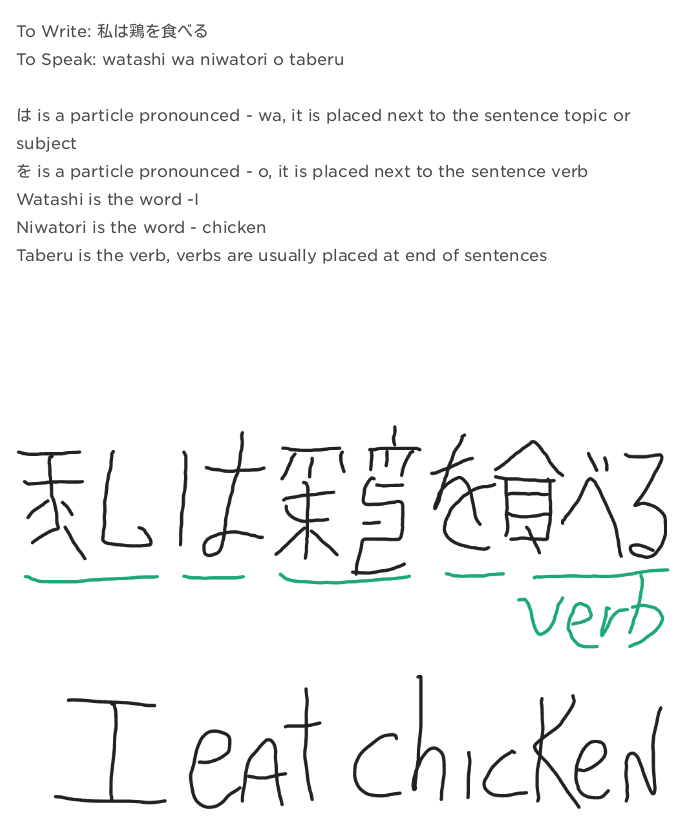
You will know it is a 'long vowel' because there will be 2 or more vowels within the word as shown in these example
words- keeki and hanbaagaa.
The word keeki has two e vowels, and hanbaagaa has two a vowels twice in the spelling, so when
writing the letters for these words, you just add the - where the additional vowels are; as shown here.
ケーキ
cake - keeki (noun)
ハンバーガー
hamburger hanbaagaa (noun)
Particles
In Japanese, particles are used to give meaning to your sentence composition.
The Japanese language has almost 200
particles(View all), and although
they are all used in sentences, some are used more often, making them
easier to learn - like wa, wo(o), ga, ni, to, yori, kurai, shi, koso, dake, nomi, nari, ka, to name a few.
As there are no spaces in Japanese writing, knowing your particles can
help to find the individual words within a sentence.
Lets look again at our example sentence - 'I eat chicken', in Japanese writing, and find the particles.
The particles for this sentence are in green color. Now we know what words are before and after our particles.
私は鶏を食べる
Watashi wa niwatori o taberu
は particle wa
を particle wo pronounced o
は particle is placed after the Topic or Subject of your sentence, and your Topic/Subject is commonly the first word of your sentence.
を particle is placed before your verb in a sentence. You can have more than one in a sentence depending on how many verbs are in your sentence.
So, for this simple sentence, we placed our は particle after the word I (watashi- subject of sentence), and
we placed our を particle before the sentence verb (eat -taberu,verb of sentence), written as wo or just o.
Verbs in Japanese Writing
Verbs are placed at the end of sentences when writing Japanese. If the sentence is a question, then ka (particle) is at the end
of the sentence and the verb is usually placed before it.
And, verbs don't change to a plural form when the sentence 'subject' (noun/pronoun) changes to plural form. Take this example;
'I eat chicken', uses taberu (verb), and 'they eat chicken', also uses the same verb, taberu.
The sentence 'subject' -I(watashi)(pronoun) is single. The sentence 'subject' they (kanojora)(pronoun) is plural.
i eat chicken
Written as:
私は鶏を食べる
watashi wa niwatori o taberu
they eat chicken
彼女は鶏を
食べる
kanojora wa niwatori o taberu
ALSO READ: Forming Japanese Sentences
For: constructing a Japanese sentence - with verb tenses, and how to use particles.
To Master Japanese Writing
To master Japanese writing you must first become skilled at Japanese Hiragana; one of three Japanese alphabets.
When learning to write Japanese, first learn Hiragana alphabet letters; they include the single letters, as well as two letter, and three letters together. View them here, chart of hiragana Japanese letters and, view some common English words written in hiragana here Knowing how to write hiragana letters is essential to be able to write Japanese words, particles, nouns; and to decipher Japanese sentences.
In Japanese writing, particles define the purpose and function of words in a sentence. Learn the meaning of each and where to place them in a sentence; especially the more common particles like: wa, wo(o), ka, ga, no, ni, ne, ya, mo, de, yori, kara, to, nari, noni, yara, koso, yo, dake. View a list of Japanese particles here. and, how to use particles in sentences, and for some example sentences with particles gohere
Verbs form the basis for sentence structure and meaning in Japanese writing. They can be formal, informal, present tense or past tense. View 'how to conjugate verbs to past tense informal'. Study a 'verb list', for Japanese verbs; to learn the more common present tense verbs. View a Japanese present tense verb list here Studying the present tense verbs is actually easy, because they most end with u, ru, ku, mu, su.
Learn all the verb tense conjugation rules for Japanese. Verbs are written differently for present and past tenses.
First learn the informal present tense and informal past tense of common verbs, then continue with formal present tense and formal past tense. Knowing the hiragana alphabet letters, together with some common verbs (past/present tenses), and some particles; is sufficient for you to start writing words and simple sentences in Japanese.
Most words and sentences can be written using hiragana, so practice writing hiragana letters first as they are the easiest to learn. Write words and simple sentences to become skilled at hiragana writing. To master hiragana, you should be able to write the letters, combination letters, and be able to find them easily in Japanese words and sentences. For speaking Japanese, you should learn how to pronounce each of the letters as well.
Use an online English to Japanese translator to do word searches for Japanese words, and use them to practice writing your hiragana letters.
Additionally, you can learn some Katakana Japanese alphabet letters(characters).
View Chart of Katakana Letters here
Katakana alphabet letters are spelled/written differently than Hiragana, however, they are pronounced the same and they mean the same. Therefore, Hiragana and Katakana can both be used when writing a word.
Each alphabet has 46 letters, and some combination letters. Katakana has additional letters that Hiragana does not have. There are about 25 of them as shown here.
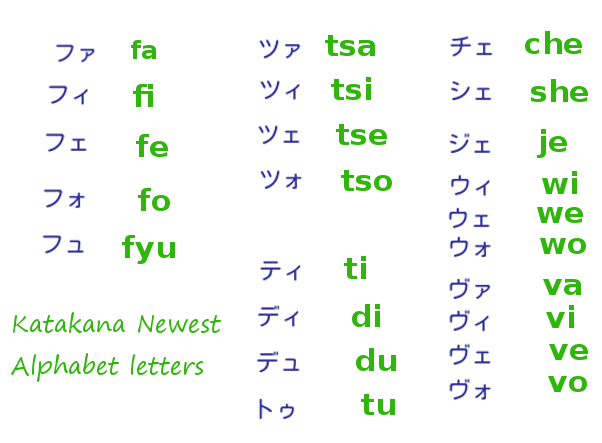
For Hiragana Chart GoHere
As with Hiragana, you need to learn to write the letters(characters) of Katakana and know how to pronounce each of them as well.
Learn To write Hiragana letters here; and, Learn To write Katakana letters; gohere
Finally, you will want to learn some Kanji. Kanji is also one of the three Japanese alphabets, and, the most difficult to
learn. Kanji is taught in schools in Japan, with students learning about 2000 of them. Kanji characters are also known
as 'ideographs'.
Each Kanji character is written using a
specific stroke order and each has a specific number of strokes, known as 'stroke count'.
Kanji is also categorized by simple to more difficult Kanji based on the 'stroke count'. This Japanese website has Kanji lessons 5, 4, 3, 2, 1. ; five being the easiest to learn, and with 'less strokes' than the more difficult Kanji.
You can also research Kanji words using online Kanji dictionaries, like the ones at these websites: romajidesu and, tangorin Just use an English word to get spelling and meaning in Japanese.
Hiragana and katakana - the Japanese alphabets; can be self taught in a reasonable amount of time. How often you practice writing them will ultimately determine your comprehension level and time it takes for you to become sufficiently skilled. Japanese particles, together with common word verbs and nouns can also be learned rather easily. As Kanji is more difficult to learn, you can start with easy Kanji (less strokes). View some easy Kanji words here
YOU MAY LIKE:
Japanese Nouns Written |
You May Like:
Shoot Like Pros - Point and Shoot Camera Tips |
Develop Game Apps for Android Free Tutorials