Writing Verbs in Japanese
Also Read - The Basics: Forming Japanese Sentences | Conjugating Verbs
To write verbs in Japanese, you must first learn the Japanese alphabets, of which there are three - Hiragana, Katakana, and Kanji. As discussed in earlier lessons, Hiragana is usually learned first, as it is the easiest to learn. Then, some Katakana, is learned along with some common Kanji characters.
To view single letters and combination letters of the hiragana Japanese alphabet(characters) Use the chart at our website.
Like the English language, the Japanese language has many verbs, however, Japanese verbs are somewhat unique.
For instance,
many present tense verbs end in ru and ku. Also common is verbs ending in su, tsu, nu, bu, and mu -
View some common verbs here
Verbs in Japanese don't change form when the sentence subject changes from singular to plural, as they do in the English language. Japanese verbs can also be changed to formal and informal tenses, and negative and past tense negative form.
Sentence Structure - Verbs
The Japanese sentence structure is unique because 'verbs' are placed at the end of a sentence.
How verbs and words in Japanese are written is unique also.
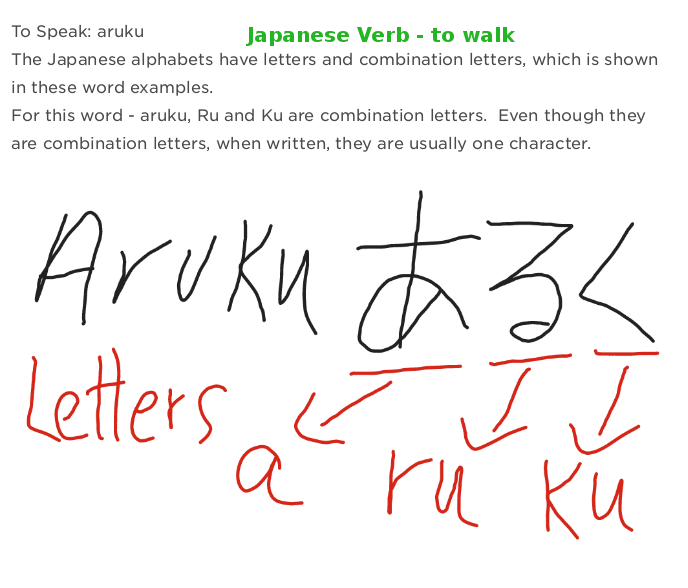
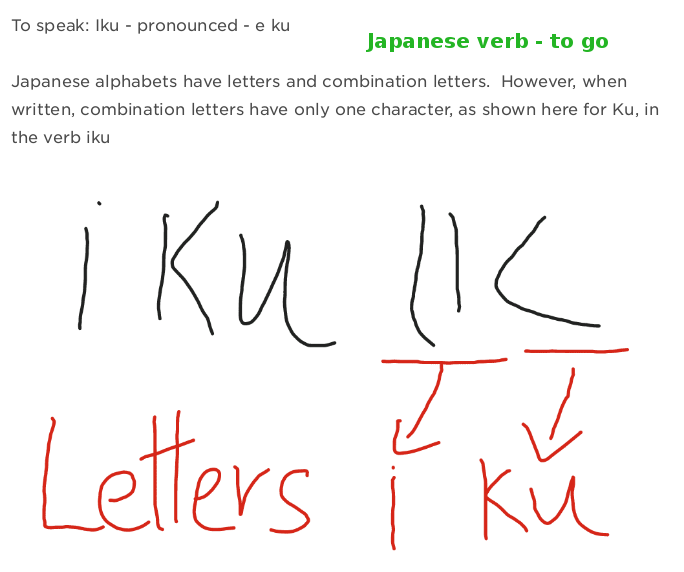
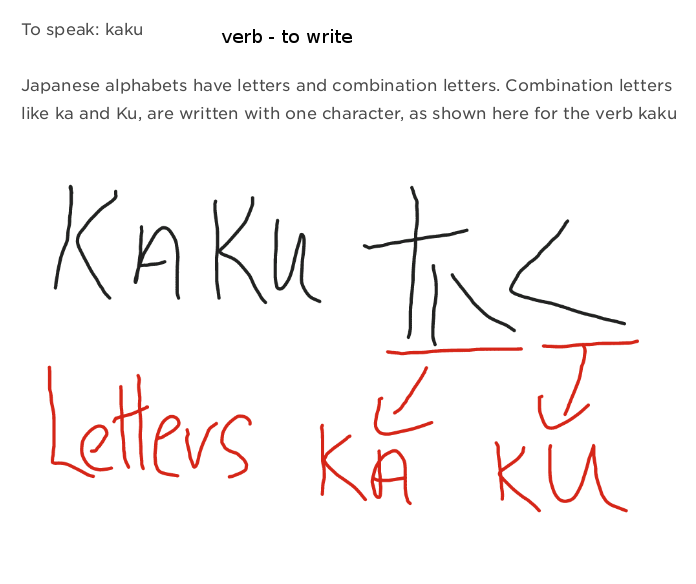
Two and three letter alphabet words, are often written with just one character as shown in the examples on this page.
And, the spoken word is different from the written word:
Example the verb:
aruku (present tense), is written as:
あ る く
View how to write each hiragana character here
COMMON VERBS IN JAPANESE
Written
Verb: To Walk
Verb: To Go
Verb: To Write
In Japanese writing, verbs are either present tense or past tense. Unlike English, the Japanese verbs do not have a future tense.
Verbs can also be formal or informal depending on who you are speaking to. Usually the informal verb is used when speaking with
those you are known to or familiar with, and, the formal verb is used when the person is not known to you or they are of social status.
Here are examples for different verb tenses for the verb - write.
Present - kaku
informal past - kaita
informal negative - kakanai
informal past negative - kakanakatta
formal past - kakimasu
formal past - kaitimashita
formal negative - kakimasen
formal past negative - kakimasen deshita
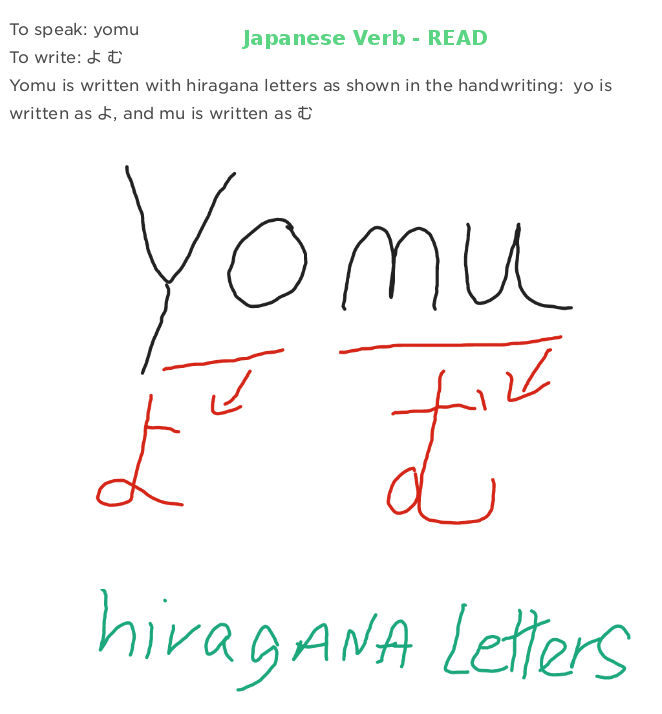
Verb: To Read
TRY THESE WORDS
Japanese verb 'think', is 'omou'.
Japanese verb 'talk', is 'hanasu'.
Japanese verb 'know', is 'shiru'.
If you Liked- 'Writing Japanese Verbs', Give Us a Social Mention
You May Also Like:
Japanese Writing Basics: Easy Lessons | Spanish Travel Phrases FREE!
Tokyo Landscape Image Designed by Freepik